
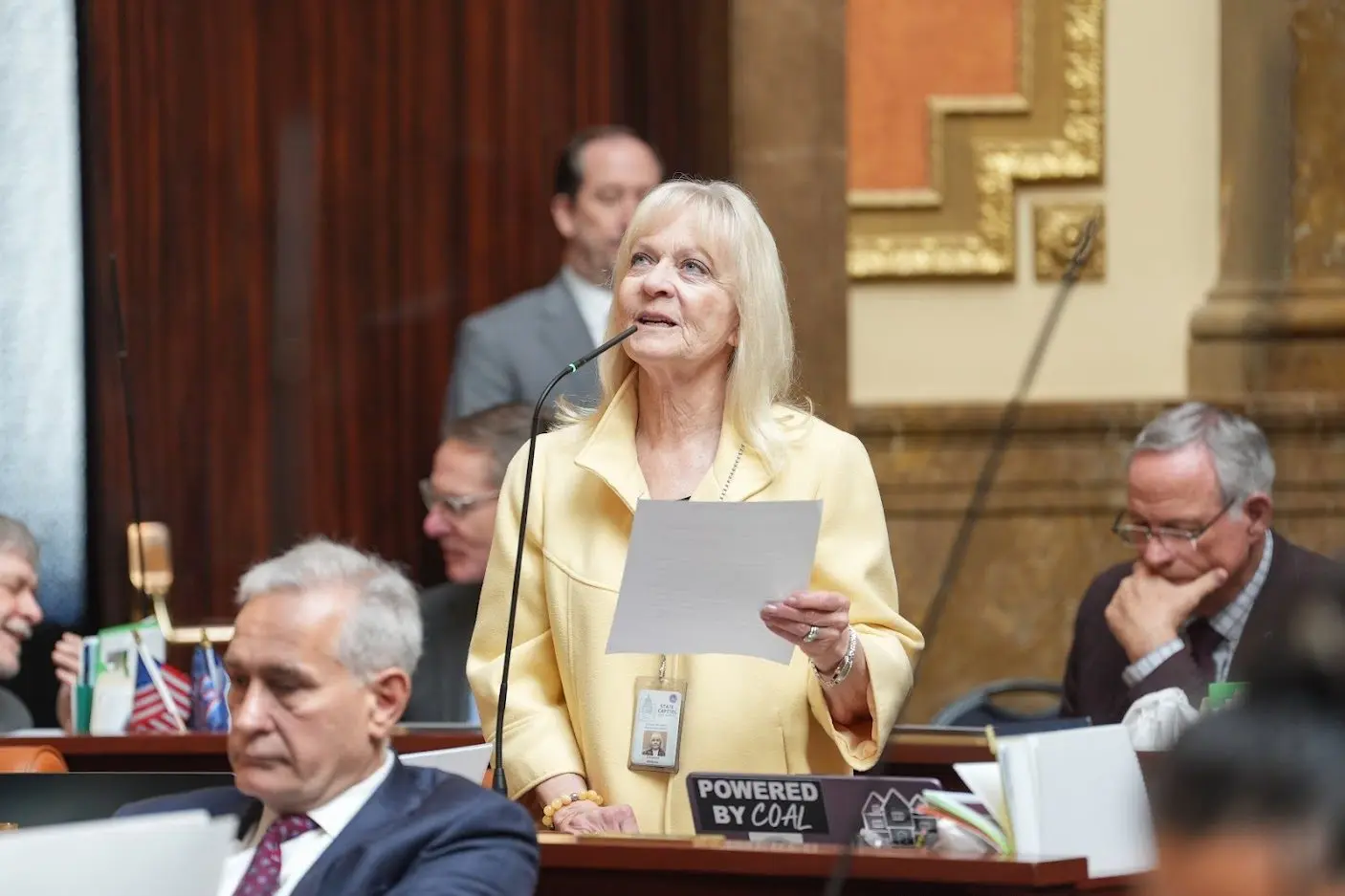
By Aidan Mortensen | KOAL News | Photo courtesy of the Utah House of Representatives
The nonstop action of Utah’s 45-day legislative session came to a close on Friday, March 6. A session that saw a record number of bills introduced at 1,016 – with only 540 making it to the governor’s desk – also served as the final session for HD67 Rep. Christine Watkins.
Watkins joined the KOAL newsroom to recap the session and provide advice for the next representative who fills her seat.
Opening our conversation, Watkins spoke about arguably the Castle Country’s biggest win during the session: the purchase of the East Carbon Coke Ovens.
“I laid awake at night trying to figure out how to pay for them once I found out they weren’t ours,” said Watkins.
“As people learned about them in the legislature, they were just in awe that we had them and they didn’t know about it. So part of the funding is for the state park service because the state of Utah is buying it. They’re going to be able to come down and work with that community and do what they would like to do with them.”
Moving from the world of appropriations to actual legislation, Watkins covered the bills she introduced that reached the governor’s desk, starting with HB468, the Mobile Mammography Amendments.
“We have three mammography mobile units that go around rural Utah so women can have the mammograms done. The issue was that not all insurance companies were covering it,” explained the representative. “So I had the Utah Medical Association come to me and say, ‘Will you run this bill?’ I was running another bill dealing with breast cancer, but it had quite a big fiscal note. And so, what we did was just substitute this one for it. They had managed to work everything out.”
Moving from medicine into energy, Watkins spoke on HB401, which directs Utah State University to conduct a study on geothermal energy development.
Initially, the bill directed the Department of Energy Development to conduct the study, but financial restraints required the move to USU to be made: “We hadn’t been able to find any funding, so Friends of USU stepped in, and they added a few things to the bill on the senate side. So it had to come back to the house side, and we did approve it.”
The third bill Watkins was able to pass through the legislature served as a cleanup bill for a previous piece of legislation in HB105.
“The legislature passed a bill last year dealing with people who have gone through the family court system, and they lost custody of their children, but if they’ve cleaned up their lives and can prove that they’re doing well, they can now petition their ex-spouse and the court to get some custody time of their children. And the judge had said, well, the legislature didn’t make this retroactive, so we did that, and it passed.”
If signed, HB105 goes into effect on May 6.
The final bill Watkins had passed deals with a topic she has a long history in: education. HB75 garnered statewide attention for its efforts to create a plan for targeted K-12 efforts for the state’s indigenous population.
“We’ve already funded these schools and these districts in the rural areas dealing with the Native Americans, but what we didn’t do was create a plan. Now, I know that sounds silly, but we just kind of forgot. And so, this was done a number of years ago by another representative, and so what we did was we came back and just put some guardrails, and said, ‘You need to work with the tribe’s school districts.'”
Moving from individual bills to some legislature-wide efforts, Watkins discussed this year’s income tax cut, which marks the sixth year in a row the state has lowered the income tax rate. By itself, the cut is expected to save the average family $40 a year.
“It’s been something that the legislature’s worked really hard on this year. It was hard because of what the federal government imposed on the state. We were asking every appropriation committee to cut five percent, so that we could still cut income tax, even though it’s not a huge amount, which helps families, along with a number of other bills that we did.”
In total, the rate drops by 0.05 percentage points to 4.45, a move expected to cost the state $101 million.
Another rate drop came in the form of a $0.06 reduction to the state’s gas tax, a move that originally drew condemnation from the Idaho State Legislature. “They really changed how they were going to do it. What they’re going to do is increase production in Woods Cross with our oil refinery refineries.”
Originally, the bill would have cut the gas tax consumers pay in Utah by 50% and impose a tax on refineries by the same amount.
Looking at the session as a whole, Watkins discussed what she considered one of the biggest wins for the state and Utahns. “I was one of just about three or four that voted against the election bill in the House, and it just got killed in the Senate. But that’s because I was listening to my constituents, who were saying, “Do not impose these new regulations just to vote.”
She continued,” They were going to really make some changes, you would have had one of three choices as to what you do and how you do it. It was so complicated, and I’ve listened to all the reports on how we vote in Utah. In the last election, four people in Park City voted twice. Now. It was discovered they were charged. But to me, this bill was like a solution looking for a problem. We had Mayor Lenise (Peterman) come up and speak against it in committee, and it was just going to be an unnecessary expense for rural areas, and that’s why I was happy that we defeated that.”
With this marking her last session in the legislature, Watkins recounted emotions running through her head as the session came to a close: “Well, I was ready for it. Since I lost my husband, I didn’t have anybody at home to keep the home fires burning, and it was really hard to come home and get everything put back together, etc., etc. So when I decided not to run, I felt like I had made that decision without pressure, without anything negative.”
Looking back at her tenure as a whole, Watkins reflected on her career in the legislature,” I’m not one of those legislators who go out and just do the really flashy, big, controversial stuff. So, to me, 95-98% of the bills I ran came from my constituents. I was good at it because they weren’t those big, flashy, controversial ones. The strength I have in leaving and feeling proud of my work is that I changed some laws that will really affect the everyday lives of Utahns.
Closing our conversation, Watkins left a piece of advice for the next representative to fill the HD67 seat.
“The one thing I found the most important was that you always want to be friends with everybody? That’s great. But what you need to establish right out of the get-go is what you do, and your word of how you’re going to say things and do things. It is very important to you,” explained Watkins. “That you are not going to tell one group of people one thing and then go to another group of people and tell another group another thing. Another thing that you can be trusted in is how you’re going to vote, how you’re going to feel about things, and every year is different, but the one thing that you want to establish is trust.”