
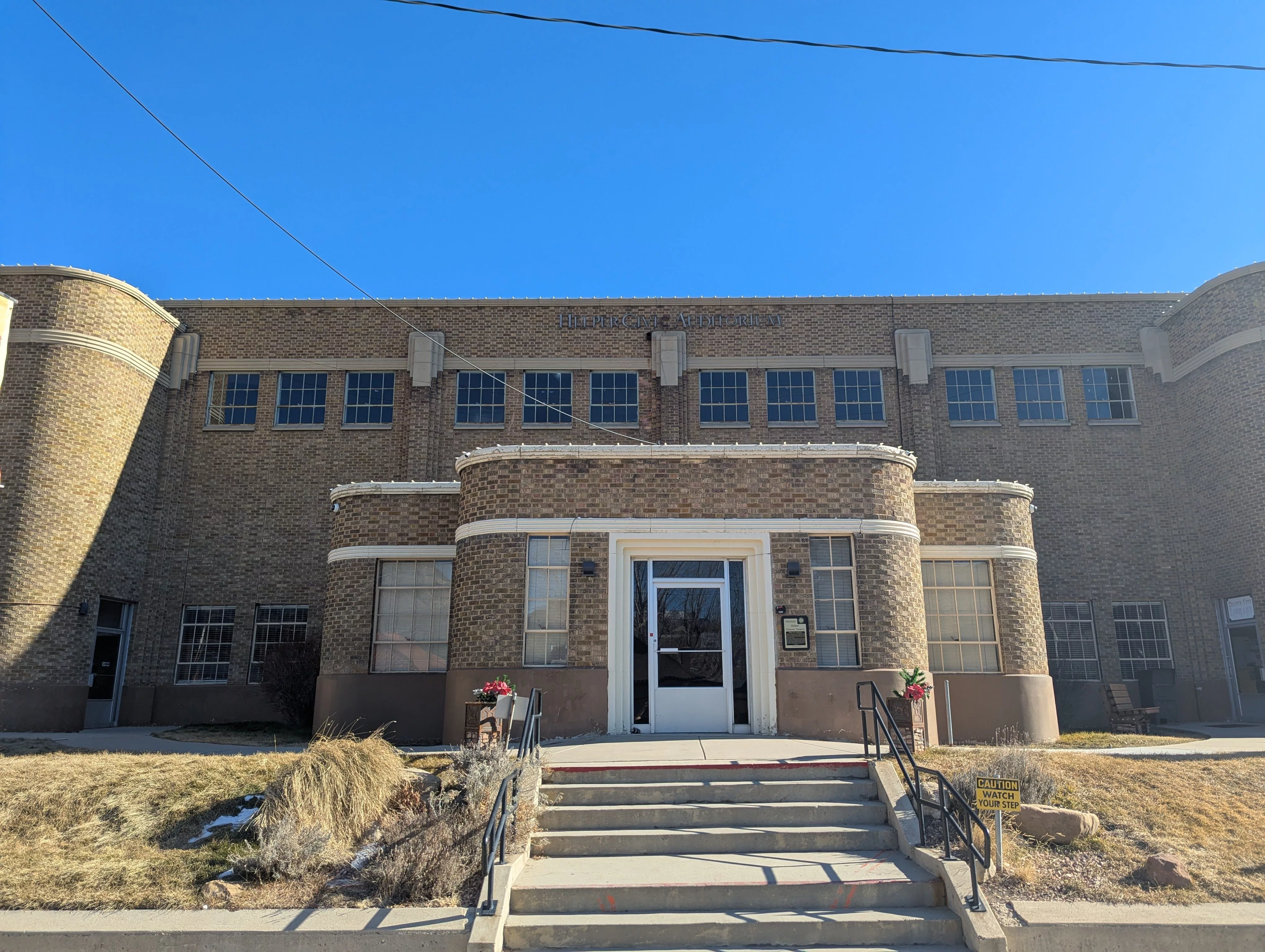
By Aidan Mortensen | KOAL News
Chaos filled the chambers of the Helper City Council on Thursday, March 19, as the council convened for a special meeting of the body. The item that drew ire from community members was an intent to begin the surplus process for property located at 69 South Main Street in the city.
The property, which Preservation Utah describes as a historic ‘boom town’ style false front, was moved to its current location in the city in 1928.
In a statement from the organization, they speak against the potential surplus of the property: “This building is an irreplaceable part of Helper’s historic fabric and a recognized component of a National Register district. It represents the earliest period of commercial development on Helper’s Main Street – a period that nearly vanished in the fires of 1919, and it carries that history as one of the last surviving witnesses to how this town began. Once a property like this leaves public ownership without adequate protections, the community loses meaningful oversight over a resource that belongs to all of them.”
Opening the public comment period on the item, Mayor Lenise Peterman explained that each individual speaking, whether in support or in opposition, would be given two minutes to speak.
“I’m sorry to have to take this opportunity to voice my opinion that I’m opposed to selling that building,” said one citizen. “I believe that there’s great value in that building. Cities like ours, where we see coming together [sic]. I mean, the progress that we’ve had in the last few years, would be looking for money to purchase the oldest building in town so that we could have a historical Society well established in a building that deserved it.”
Speaking in a neutral position on the item, former councilman Dave Dornan took the podium. “I see a value [sic] of getting things in private hands so that things can move forward. I’ve seen private hands put it in an alleyway next to our building. I’ve seen alleyways abandoned by the city that used to serve as garbage access, that type of thing.”
He continued,” I think that a lot of consideration obviously is going to go into this, but I believe that as you analyze what is occurring, that you say, what is best for Helper City. That’s a responsible body, and I’m sure you will. But I just stand here to say, I’ve seen a lot of places, including Pierpont Avenue in Salt Lake taken over by artists and all of a sudden, it burgeons, and that is what happened in Helper.”
Speaking against the proposal, Kathy Fausett approached the council. “I think, first of all, we need to have a little truth-telling session about why we have to pay for the paving of the road, the entire road. That’s why we need the money. That Helper City made three cuts into the road. It seems to me we would be responsible to repair three places in the road. I would like to see the actual documentation that somebody is ordering us to replace that road.”
Later in the meeting, Fausett’s comments were addressed head-on, with Mayor Peterman explaining,” Kathy referenced the road that we need to repair. We did a $4 million water transmission line project. In doing so, we have a commitment to those three private property owners to return the road to as good as when we did our project.”
Peterman added,” We looked at if Helper City could do the work? We looked at whether the county can help us out and do the work? We looked at a contractor doing the work. I pursued funding from the Governor’s Office of Budget. I’ve looked at grants, I’ve looked at all different avenues, and I came to council and said, I have exhausted [sic] figuring out how to fund this last final piece of this project, which is where the idea of perhaps looking at Helper City property would be what we would do.”
Fausett also shared concern over what a private owner could utilize the building for: “The next person could put in whatever they want to. They put you know, the bookstore or the sex shop. I mean, you cannot control [sic] other than our ordinances.”
Moving to another neutral comment, Pam Juliano, the current tenant of the building, addressed the issue, explaining that when she first leased the property, she understood that the city might or might not decide to sell it. As such, she had a right of first refusal clause added to the lease, giving her the option to purchase the property in such an instance.
“It’s getting a little ahead of the conversation if I’m understanding the process correctly. This is simply the announcement to discuss whether you’re going to put it up for sale or not,” stated Juliano. “And then, after that, to Kathy’s point, it needs to be assessed. What is that value? What’s the best use for that building?”
She continued,” And I would certainly hope that there’s value in what I’ve done. I’ve allowed USU Extension in there. The Helper engine is in there. The Art Festival is in there. We use it for community. I have a business itself that they come in for meetings. So it’s been used as a business place, but also a community location, and we’ve recently become a quasi information center when I’m in town.”
Next to the podium was Stephanie Ariotti, who stated,” I want to express that I do not feel selling the city-owned assets, particularly long-term decision properties like this, can hold significant future value both financially and strategically in ways we may not fully realize today.”
Ariotti added,” Once it is sold, the opportunity is gone permanently. For example, Helper City disposed of a vacant land west of Gardner Field, which today would be a great all-wheels park option. I encourage the council to slow this process down, ensure full transparency and completely appropriate due diligence before moving forward.”
Next was Malarie DeVincent, who stated her issue with the item was regarding the procedure and process surrounding it. “I think we’re putting the cart before the horse. You need to determine whether or not the building meets the requirement for the definition of surplus, which I don’t believe that it does.”
Following DeVincent, Marilou Kundmueller, a member of the Helper City Historic Preservation Board, addressed the matter. “I have witnessed the support of the city in helping historic building owners get grants and promote introductions to preservation professionals closely with the State Historic Preservation Office and Preservation Utah by making decisions about our town. Chaos ensues when concerns are not addressed in a professional and polite manner. In the spirit of cooperation, and I think that’s what’s most important here, is that we do what’s best for the building cooperatively. If members of council deem it in the best interest of the town to sell this, the oldest remaining building on Main Street, I trust that you will do it with respect and caution for its survival.”
Other citizens gathered to speak against beginning the process, with one referring to the item as a ‘fire sale’ by the city. Others expressed interest in bidding for the property if it were to be surplused.
Attempting to battle through crowd interruptions, Mayor Peterman spoke to the council, explaining her concerns with the item,”What we have here is we have completing code. That’s what she’s (DeVincent) referencing, the definition of surplus property, and this, which I don’t really like, surplus in this.”
She added,” Our code needs to be rewritten. We’re undertaking steps to do that. But at this point, what I’d like to do is entertain a motion and table this until we can resolve it properly, right? Because we do have conflicting code, you know, the definition of surplus versus this is different, so we need to get with our legal counsel to pursue that.”
Throughout the explanation, Peterman faced interruptions from DeVincent, which eventually led to her being escorted out of the meeting.
Before the motion could be completed, councilmember Bob Olson addressed concerns citizens had raised with him about the city’s plan to sell the Big John statue, stemming from a satirical social media post by DeVincent in the lead-up to the meeting.
“I don’t think any of us would ever consider selling Big John. That’s a landmark. It’s going to be there forever. It’s going to be there way after all of us are dead and in the grave. Everybody loves Big John. So, because of that, animosity was created. I don’t know, because I don’t get on Facebook that much, apparently, the word on the street is that the council is going to consider selling Big John. We’re not, folks. We’re not taking bids on Big John.”
Following Olsen’s remarks, the crowd at the meeting attempted to make further public comments, but the mayor and council said the time for public comment had passed. This created a tense environment as a chorus of shouts filled the chamber until Police Chief Sean Draper intervened.
Following the intervention, Ariotti stormed from the building, accusing the council of ‘playing fast and loose with the public’ because the notice for the special meeting was posted only 48 hours in advance.
Per Utah State Code 52-4-202, public meeting notices and agendas must be posted 24 hours in advance of the meeting, a requirement that Helper City met.
At the conclusion of the crowd outburst, the council unanimously approved the motion to table the item, bringing the meeting to a close.
The vote to table allows the council time to update conflicting city code and clarify the surplus process before any decision is made regarding the property.