
By Brooke Larsen | The Salt Lake Tribune | Photo by Trent Nelson | The Salt Lake Tribune
Utah and its neighbors in the Upper Colorado River Basin shared a resounding message on Tuesday: it’s going to be a rough year.
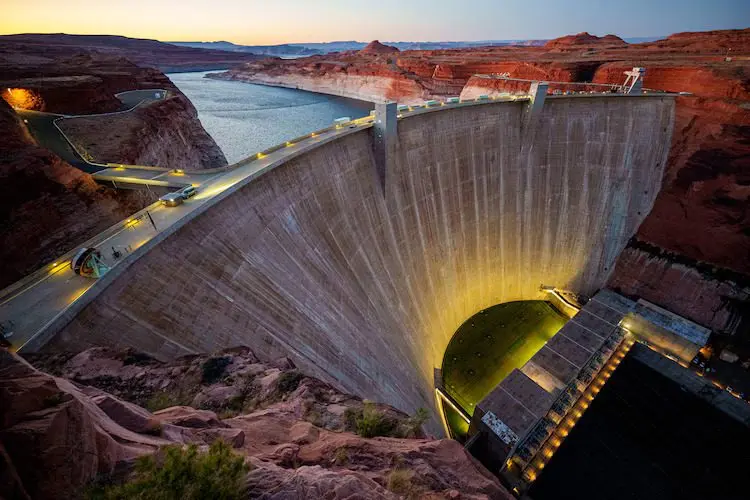
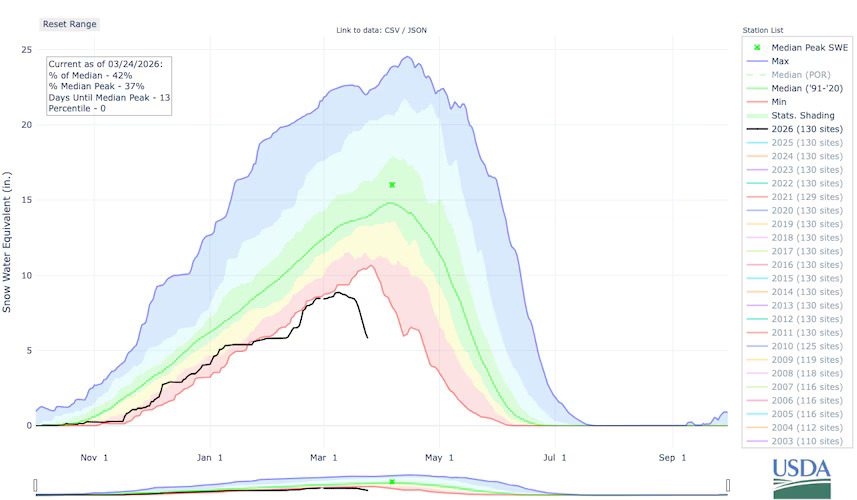
Snowpack peaked weeks earlier than usual, and set a record low. The latest forecasts show Lake Powell dipping below the level where Glen Canyon Dam can generate electricity or sustainably release water downstream by the end of the year. And states still can’t agree on how to manage the shrinking water supply for 40 million people after the current guidelines expire at the end of the year.
“The situation is dire. The stakes have never been higher. And unfortunately the reservoirs have never been drier,” Estevan López, New Mexico’s Colorado River negotiator, said during a meeting of the Upper Colorado River Commission on Tuesday.
Since January, states, Upper Basin tribes and the bureau have been working on a drought response agreement for releases from those reservoirs, Chuck Cullom, director of the Upper Colorado River Commission, said.
The states and the bureau aim to have a final draft plan by the next meeting of the commission on April 24, he added. If Upper Basin states approve it, the plan will get sent to the Interior Secretary and go into effect on May 1.
Releases from upstream reservoirs will likely total around 500,000 acre-feet.
That additional flow to Powell will be “woefully insufficient” without adjustments to how much is released out of Glen Canyon Dam as well, Gene Shawcroft, Utah’s negotiator, said during a meeting of the Colorado River Authority of Utah on Tuesday afternoon.
To keep Powell at 3,500 feet, the bureau will need to find an additional 1.7 million acre-feet of water to keep the reservoir from dipping to critically low elevations, Shawcroft added.
The bureau could reduce Powell releases from its currently planned 7.48 million acre-feet to as low as 6 million acre-feet, according to a plan finalized in 2024.
That will inch Colorado River operations closer to a legal “tripwire,” as experts call it, when the ten-year combined flow of the river at Lees Ferry sinks below 82.5 million acre-feet — an amount Lower Basin states say the Colorado River Compact requires Utah and its upstream neighbors to deliver.
This would be the first time such a breach happens. “The risk of litigation is high,” Shawcroft told reporters during a press briefing last month.
That risk is not only going up because of the hydrology, but also because states can’t agree on how to move forward after current guidelines expire at the end of this year. There’s hope that short-term agreements to avert a crisis at Powell this year may move states closer to a future deal, though.
“Our goal is that an agreement on the near-term operations will allow us to continue talks about the long term,” Brandon Gebhart, Wyoming’s negotiator, said. “All seven states are still at the table. We are still talking. We have not come to an agreement yet, but we can’t stop.”
Negotiation sticking points
Negotiators expressed both commitment to reach an agreement as well as skepticism about the seven states’ ability to break free from key sticking points.
One of the key tensions has been a call from Nevada, Arizona and California for enforceable conservation by their Upper Basin counterparts — Utah, Wyoming, New Mexico and Colorado.
“Some Upper Basin interests remain unwilling to commit to measurable conservation and reductions, even though the Compact ultimately places delivery obligations upstream,” JD Hamby, California’s Colorado River negotiator, said in a statement when states failed to reach a deal in February.
Upper Basin states argued that demand was “completely inappropriate,” López said, “given the very real and mandatory reductions that are imposed by Mother Nature.”
During dry years, less water flows through the headwaters of the Colorado River and its upstream tributaries, such as the Green and Price Rivers and smaller streams in Utah.
State engineers in Utah and the other Upper Basin states cut off water rights holders, such as farmers, tribes and cities, based on priority, or seniority, of their rights.
“When there is less, we use less,” Becky Mitchell, Colorado’s negotiator, said. “This is not voluntary, and no one gets paid.”
Due to this year’s notable drought, Upper Basin states will cut off users “earlier and deeper” than in previous years, including some of the most senior water rights dating back to the 1800s, Mitchell added.
The Ute Mountain Ute Tribe faces a 70% cut to its water supply in Colorado. “That doesn’t come without pain,” she said.
Nevada recently offered up a short term solution that doesn’t include additional cuts in the Upper Basin. The proposal includes a two-year plan to maintain levels at Powell and Lake Mead, as well as guidance on how a negotiation process could look in the years following.
It puts Flaming Gorge and the other upstream reservoirs as “the first line of defense in protecting Lake Powell.”
But how those reservoirs are managed and how much is released from them remains a sticking point between the Upper and Lower Basin states, Shawcroft said.
The states have engaged in some discussion around this proposal and shared comments, he added. “But it doesn’t seem that that’s going to be the magic bullet that will help us get to a seven-state agreement.”
Whether states reach an agreement or not, the feds must make a decision on how to manage Powell and Mead and other upstream reservoirs by Oct. 1 — all while also preventing a crisis at Glen Canyon Dam in the short term.
“Our preferred outcome of the seven basin states discussion is consensus,” David Palumbo, deputy commissioner at the Bureau of Reclamation, told the U.S. Senate’s Water and Power Subcommittee last week. “But … it is incumbent upon the Bureau of Reclamation to operate the system responsibly within our existing authorities.”
This article is published through the Colorado River Collaborative, a solutions journalism initiative supported by the Janet Quinney Lawson Institute for Land, Water, and Air at Utah State University. See all of our stories about how Utahns are impacted by the Colorado River at greatsaltlakenews.org/coloradoriver.