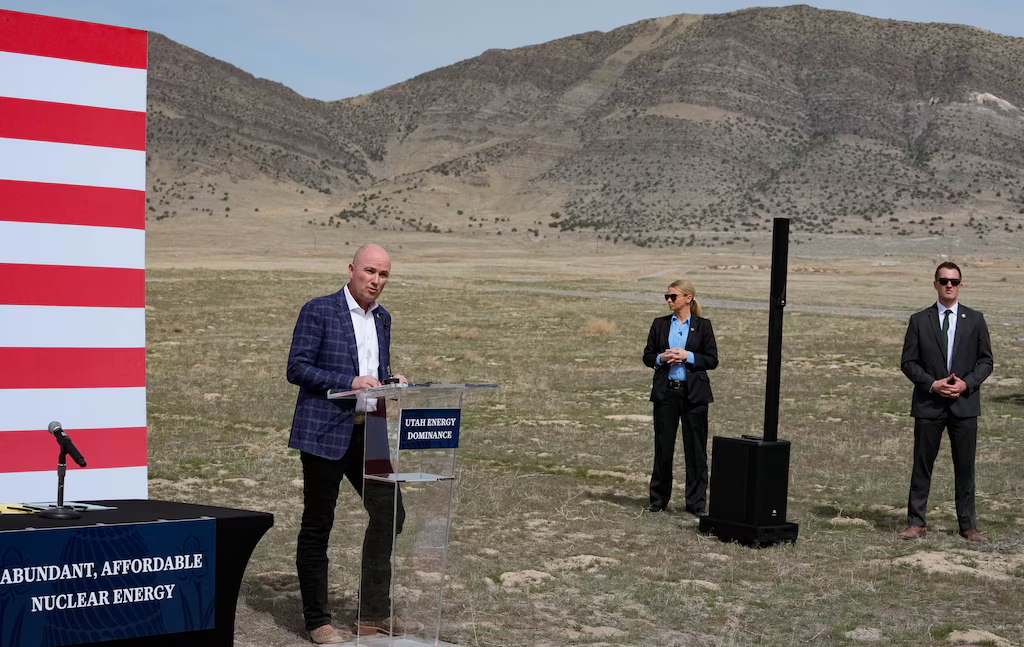
Standing in front of a sprawling American flag last week, Gov. Spencer Cox said his administration has a simple goal: to “build the safest, most complete nuclear energy ecosystem in the country, right here in the state of Utah.”
This week, the state took a key step toward achieving that objective.
Utah submitted a 150-page proposal on April 1 to the U.S. Department of Energy seeking to bring a massive federal nuclear hub to the Beehive state. The “nuclear lifecycle innovation campus” could include fuel fabrication, enrichment, recycling of spent nuclear fuel and nuclear waste storage. The state is expected to compete against several other states for the project, which would largely be funded through private investment.
But Utah’s pitch goes beyond plans for a single campus.
While Cox made his announcement in Tooele County’s remote West Desert, the “nuclear energy ecosystem” Utah is proposing stretches from Box Elder County in the north to San Juan County in the south.
Cox noted Utah’s “vast stretches of vacant, state-held” lands in “unpopulated desert regions,” among other assets.
“Utah is ready, willing, and able to write the next chapter of American energy dominance,” the governor wrote in the application.
Here are five key takeaways from the document.
A statewide ‘nuclear ecosystem’
The state’s application maps out a sprawling network of sites and projects across Utah it says can handle every stage of the nuclear fuel cycle.
Utah already has the White Mesa uranium mill near Blanding and uranium deposits at the La Sal, Pandora and Velvet-Wood mines in San Juan County.
In central Utah, the San Rafael Energy Lab is now home to Valar Atomics’ Ward 250 TRISO-fueled microreactor, a small modular reactor, or SMR, used for testing and research, but not for commercial power generation. The application also notes the “potential” for nuclear waste storage in Millard County’s salt caverns, as previously reported by The Salt Lake Tribune and Millard County Chronicle Progress.
For northern Utah, the application highlights Ogden’s Western Zirconium, which processes non-radioactive materials used for nuclear fuel and defense. A Nusano facility in West Valley City will produce radioisotopes for cancer treatment. In Box Elder County, state leadership announced a partnership with Hi Tech Solutions and Holtec International to build two SMRs and a nuclear training and manufacturing hub.
Utah lawmakers paved the way for a campus during their annual legislative session earlier this year with proposals designed to “build long-term institutional capacity for nuclear energy development,” the application said.
They authorized the Utah Office of Energy Development to pursue a nuclear lifecycle innovation campus and explore development of a nuclear fuel recycling facility in the state under SB135, which was sponsored by Sen. Derrin Owens, R-Fountain Green. And HB78 from Rep. Carl Albrecht, R-Richfield, established a Nuclear Energy Regulatory Office meant to streamline licensing for nuclear projects. The new office also has the authority to enter cooperative agreements with federal agencies.
The proposal from Cox’s office touts a 2025 bill introduced by Albrecht, HB249, which created the Nuclear Energy Consortium, a group of industry representatives, researchers and policymakers that advise the Legislature on nuclear-related issues.
The state’s application also notes how nuclear projects and proposals across the state are linked via major highways. EnergySolutions already regularly imports low-level nuclear waste to its Clive site on roads in Tooele, the document says, “including a recent delivery exceeding 1 million” pounds. Radioactive material also frequently moves through Utah to Clive via rail.
The Tooele County ‘energy corridor’
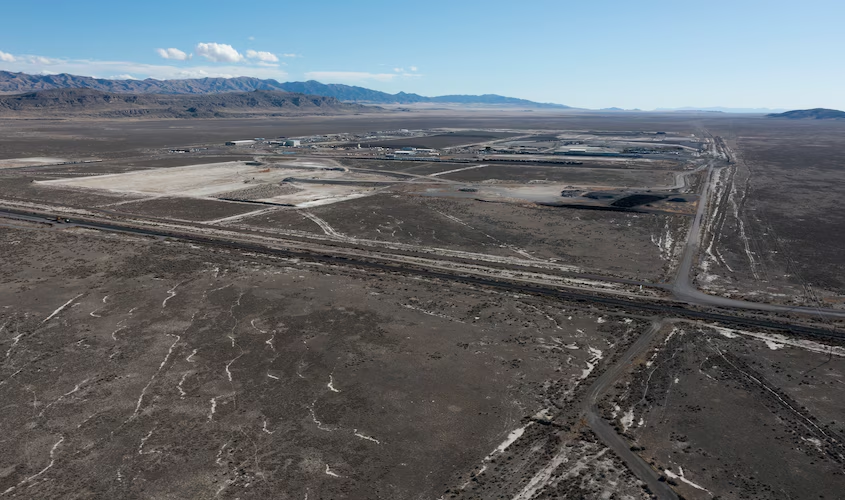
The application zeroed in on a section of Tooele County west of the Great Salt Lake for an “energy corridor,” a site that will likely host a full nuclear lifecycle campus, from uranium enrichment to fueling SMRs to operating nuclear-powered data centers to depositing waste deep below ground to reprocessing and recycling spent radioactive fuel.
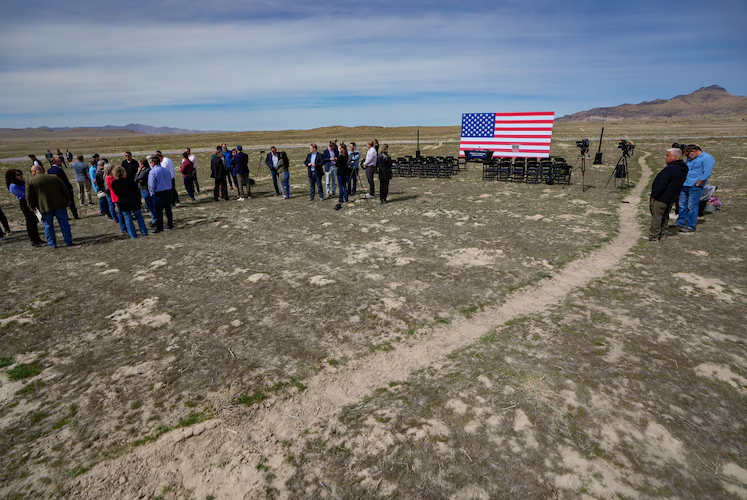
The state touts the Tooele corridor’s proximity to power lines, Interstate 80, Salt Lake City International Airport and a workforce skilled with handling hazardous materials. The nearby EnergySolutions facility in Clive has stored low-level radioactive waste for decades.
Last week’s news conference where Cox announced the proposal was held on Bureau of Land Management land in the West Desert, and was “very close” to the area proposed for the campus, Cox said, which would be located on property owned by the state Trust Lands Administration.
According to documents, there are “relatively limited” fault lines that could raise seismic concerns in the possible area for an energy corridor. However, the proposal added, the “most notable” fault lies to the west of the Lakeside Mountains — near where state officials gathered for last week’s announcement.
Major players
The application touts Utah, where the state motto is “Industry,” as pro-business, with nine active memorandums of understanding, or MOUs, with various nuclear startups.
The Tooele corridor itself has support from key local players and municipalities, including Tooele County, Tooele City, Grantsville and Erda along with the Tooele Chamber of Commerce, Tooele County School District and Tooele Technical College.
Companies and investors with nuclear interests statewide that wrote letters of support include:
Atlas Atomics – Little public information is available about this company, but CEO Kevin Gan wrote in his support letter that it is developing heavy-water reactor technology. Gov. Cox met with Gan in late February.
Battelle Memorial Institute/Energy Alliance – This nonprofit manages the Idaho National Laboratory, a nuclear testing facility owned by the Department of Energy. Both entities signed an MOU in April 2025 with Utah to develop nuclear research and training.
Blue Castle Holdings – This company has had plans to build a nuclear reactor near Green River for nearly two decades, but has yet to make much progress.
Curio – Company CEO Edward McGinnis met with lawmakers on Utah’s Capitol Hill in 2024 to discuss building a nuclear recycling facility. McGinnis was a top DOE official under the first Trump administration.
General Matter, Inc. – A startup focused on uranium enrichment.
Hi Tech Solutions – This Washington-based company set up a second headquarters in Utah. It has an MOU with the state to build a nuclear hub in Box Elder County, and has submitted a petition to run the idled coal units at the Intermountain Power Plant near Delta.
Holtec International – This global company is working on building an SMR at a decommissioned nuclear plant in Michigan. It is also partnering with Hi Tech to build the Box Elder nuclear hub and two SMRs in northern Utah.
Idaho National Laboratory – This is one of the U.S. Department of Energy’s top nuclear research centers, based in Idaho Falls.
Nuclea Energy — A company with plans to assemble a prototype small reactor at the Utah San Rafael Energy Lab.
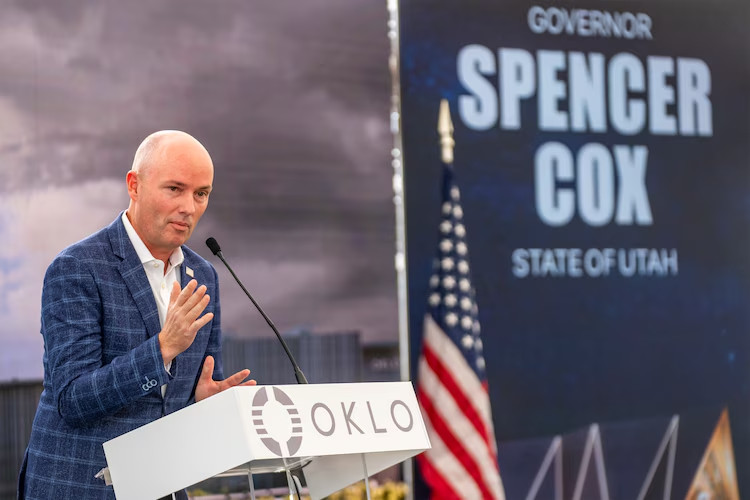
Oklo – This startup is also focused on building SMRs. Cox was present at a September groundbreaking ceremony for a test reactor the company is building at Idaho National Lab.
Rocky Mountain Power – This private utility is Utah’s largest electricity provider.
TerraPower – A Bill Gates-backed startup that is building an SMR at an old coal plant in Kemmerer, Wyoming. Last summer, it announced it was also on the hunt for a potential SMR site in Utah.
Valar Atomics – This California startup had a small test reactor flown to Utah by military planes in February. It will be used for research and testing at the Utah San Rafael Energy Lab.
All the letters of support are less than a month old.
Where will the waste go?
Utah already stores low-level radioactive waste at the EnergySolutions facility in Clive. The company recently received approval from the seven-state Northwest Interstate Compact on Low-Level Radioactive Waste Management to import similar waste from Canada. It’s the first time the compact has approved foreign nuclear material. The state is also working with EnergySolutions to license a cell for federal radioactive waste, the application notes.
Lawmakers, lobbyists and the state’s application have explored storing waste in the salt caverns near Delta, although it’s not an entirely popular prospect among locals.
“I don’t want to be the dumping grounds for nuclear waste,” Delta City Mayor KC Bogue told the Millard County Chronicle Progress last month.
The application to DOE plugs Utah’s intent to house the full nuclear lifecycle, including interim storage and a long-term repository for waste. Permanent radioactive storage and high-level radioactive waste handling is under the purview of the federal government, but Utah’s application says the state will work with federal agencies in selecting suitable parcels. It identified the Tooele corridor as a potential site for those wastes.
The application adds the state has capacity for deep geological deposits of radioactive waste, and that it would co-locate nuclear recycling facilities with at least some of those repository sites.
How do Utahns feel about becoming a nuclear hub?
The state has invested $1.8 million in a public outreach campaign to get residents on board with nuclear development. The application zeroes in on a poll exploring attitudes toward nuclear development in three counties – Tooele, Millard and Weber.
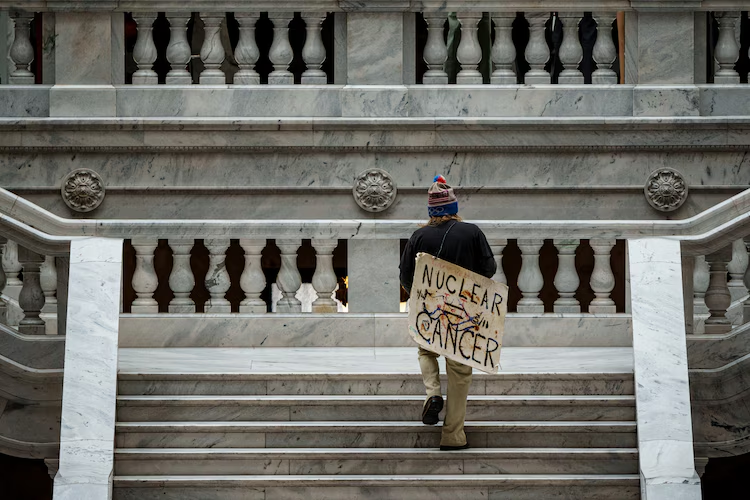
The state selected Weber County for the survey to include urban perspectives in the results. Other urban counties, like Utah and Salt Lake, have expressed ambivalent attitudes toward nuclear proposals in their backyards. Officials in Eagle Mountain tabled a proposal for an energy corridor, with the possibility of SMRs, when it proved divisive among residents. Salt Lake County Mayor Jenny Wilson publicly criticized the possibility of a uranium processing plant near the state’s capital. No known nuclear projects have been proposed for Weber County.
The poll included 608 residents surveyed across the three counties, conducted between October and December. About 68% of respondents said nuclear investment could help meet Utah’s energy needs, according to the application. But the results also reveal that Utahns have outstanding concerns about safety, with 35% of respondents saying nuclear energy carries similar risks to nuclear weapons, and 41% disagreeing with that statement.
The full application is available on the Office of Energy Development’s website.
This article is published through the Utah News Collaborative, a partnership of news organizations in Utah that aims to inform readers across the state.