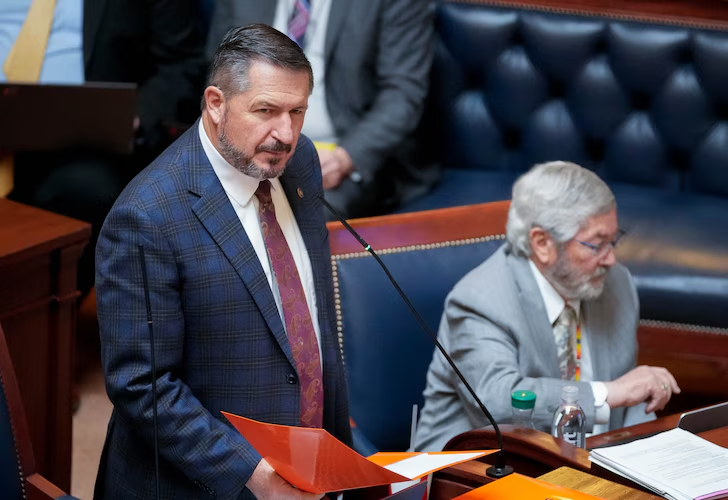
Sen. Derrin Owens, R-Fountain Green, at the Utah Capitol on Wednesday, Feb. 25, 2026.
Utah leaders are aggressively pursuing nuclear power, but a controversial “poison pill” lingers: what to do with the dangerous waste. Now the state is exploring whether to become one of the antidotes for the nation — by potentially storing nuclear waste in the massive salt deposit in Millard County.
Caverns carved into the salt dome already hold natural gas liquids, gasoline and other fuels. Separate storage of hydrogen began there this year.
The Trump administration wants states to volunteer as hosts for “nuclear lifecycle innovation campuses” — sites that will take radioactive material for a variety of uses, like storage, recycling, enrichment, fabrication, deploying reactors or powering manufacturing and data centers.
The same day the Department of Energy began soliciting states to host campuses, Sen. Derrin Owens, R-Fountain Green, contacted several lawmakers, lobbyists, private equity investors and Millard County officials, in an email obtained by the Millard County Chronicle Progress and shared with The Salt Lake Tribune.
“Friends,” Owens wrote on Jan. 28, “HERE IT IS – This is Utah’s once in a lifetime opportunity to host one of these sites.”
Owens declined to comment for this story.
The lawmaker noted the group had “tried to lay the groundwork” for nuclear waste opportunities with Curio Energy, a startup headquartered in Washington D.C. that’s developing a process to recycle spent fuel.
Millard County’s salt dome – a remnant of an ancient ocean from the time dinosaurs roamed the earth – apparently makes Utah a particularly attractive candidate. The only other state interested in becoming a nuclear waste campus that has such a formation is Mississippi, Owens noted.
“Let’s lead the west,” the senator wrote.
He further alluded to Utah’s consternation about more liberal states on the Pacific coast, which historically bought coal and fossil-fuel generated electricity from Utah and other interior states but have since pivoted toward energy sources that don’t contribute to climate change.
“They will need Utah once again,” Owens wrote, “if we land this fuel cycle.”
The senator called on the email recipients to pressure Gov. Spencer Cox’s office and the Utah Office of Energy Development to “get on the phone” with DOE and “advocate for Utah.”
The following day, Cox issued a statement to E&E News that said the state is evaluating DOE’s request “to determine whether it’s something Utah would be interested in working on with the department.”
The governor’s office told The Tribune that the state has not yet committed to a specific project or partnership.
“America needs more reliable, affordable, and abundant energy,” Cox wrote in a statement last week, “and nuclear will be part of that future. As we evaluate the entire lifecycle, including advanced recycling, we will focus on Utah priorities, including safety, environmental stewardship, workforce development, and responsible use of taxpayer dollars.”
Cox has made “Operation Gigawatt” a prime focus of his second term, seeking to more than double Utah’s energy output over the next decade. While the governor calls it an “all of the above” strategy that embraces all forms of energy, from solar panels to coal plants, his initiatives have focused heavily on nuclear development.
The governor’s Office of Energy Development declined to comment for this story. It also declined to provide any records associated with Utah’s interest in hosting a nuclear lifecycle campus, calling them classified and protected due to negotiations over real estate.
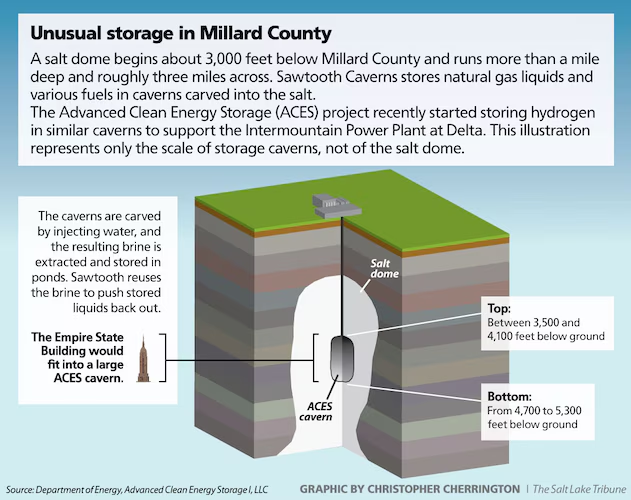
In Millard County, some see the prospect of storing nuclear waste in the salt caverns as a chance to bolster the area’s struggling job market. Others find the idea hard to stomach.
“I don’t want it anywhere close to us,” Millard County Commissioner Vicki Lyman said.
A radioactive ‘mining company’
Curio Energy, the startup Owens cited in his email, also did not respond to requests for comment. The senator had invited company CEO Edward McGinnis to Utah’s Capitol Hill in September 2024 to discuss Curio’s approach to nuclear waste with lawmakers.
“There are hundreds of billions of dollars of resources and commodities” embedded in the spent radioactive fuel currently stored in more than 80 locations across the U.S., McGinnis said. “We’re a mining business.”
Originally called “Curio Solutions,” the company was founded in 2021. It secured $15 million in seed funding in April 2024 to develop technology for building reactors and recycling their spent fuel, as reported by Forbes. And on Feb. 5, DOE announced Curio was among the recipients of a $19 million grant to further research and develop nuclear fuel recycling.
Curio’s crown jewel is its patented NuCycle process, which has been demonstrated in labs but is not yet in commercial use. The company says that by recycling spent uranium and zirconium from nuclear plants, it can extract valuable materials like critical minerals and isotopes used in cancer treatment.
McGinnis became Curio’s CEO in 2022 after more than 30 years working for DOE.
When a typical nuclear plant uses nuclear fuel, the spent radioactive rods still contain about 96% of their “energy value,” McGinnis told lawmakers.
“Curio is focused on bringing to market, for the first time, state-of-the art advanced recycling,” McGinnis said, “done in a way that doesn’t force those who want to access nuclear to really swallow that poison pill, that elephant in the room … what are you going to do with the so-called waste?”
What was supposed to become the nation’s repository for radioactive waste, Yucca Mountain in Nevada, has been effectively stalled for decades due to immense pushback from Nevadans and numerous political and legal hurdles. But McGinnis called the current moment unique, with bipartisan support for more nuclear development. Both the Biden and Trump administrations adopted policies to support fission power.
The shift to electric vehicles along with the proliferation of artificial intelligence has made global demand for energy spike. Utah leaders have called it the “arms race” of the contemporary era and an issue of national security.
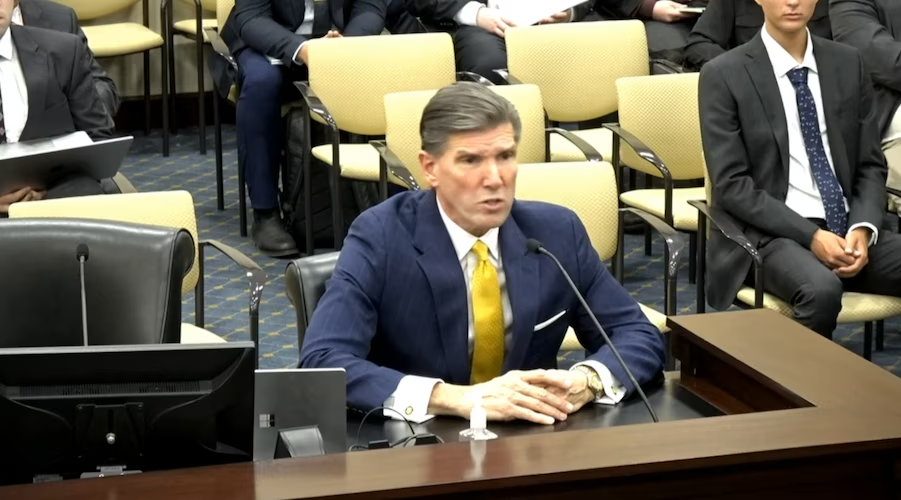
Recycling nuclear fuel doesn’t just produce valuable materials for manufacturing, medical and national defense industries, McGinnis said. It can mean the radioactivity of the country’s waste stream takes only a few hundred years to decay instead of thousands of years.
“And (we) do it in an environmentally friendly way,” McGinnis said, that “avoids passing this waste down to generations.”
Curio partnered with the Idaho, Oak Ridge, Pacific Northwest and Sandia national laboratories late last year to demonstrate its technology.
“Multiple states” have expressed interest in welcoming the company into their communities, McGinnis said, and he’s looking to deploy at least two or three facilities in the U.S. by the early 2030s.
“The facility will become a tech backbone,” the CEO said, creating high-paying jobs that don’t necessarily require advanced degrees.
‘Waste is only part of it’
The project could bring a windfall to Owens’ district, which has seen a hemorrhaging of jobs due to the closure of coal units at power plants, a slowdown in mining and the shuttering of the Smithfield meat processing plant.
“Welcome to Utah,” Owens told McGinnis during the 2024 hearing with lawmakers. “In our mining communities, we know we have to bridge having baseload power from our coal industries. This is the dream to get there.”
A series of 2024 state reports explored strategies for nuclear power in Utah, and one that focused on waste fuels lauded Curio by name. The company could create 3,000 jobs in Utah, the report projected, generate more than $400 million each year in tax revenue and super-charge the state’s economy with $1.5 billion annually.
U.S. scientists developed the first technologies to recycle radioactive waste. But the nation largely abandoned the practice due to national policies and fears over safety and weapons proliferation.
Nuclear, however, is “one of the cleanest and safest of all energy sources,” the Office of Energy Development’s report asserts. Numerous private sector startups are now eyeing radioactive waste as a lucrative product, the office wrote in the report, and “Utah should and can be primed to take advantage of this change, even leading the nation forward.”
The salt caverns, the report added, would be “ideal” for storing nuclear material. Salt caves and mines have been used for radioactive repositories in New Mexico and Germany, with varying degrees of success.
Besides lawmakers and other state leaders, Owens added Wayne Aston, founder of the private equity firm Invictus Sovereign, and lobbyists Casey Hill and Lincoln Schultz of Lincoln Hill to his email. Hill previously worked for EnergySolutions, which recently received approval to store foreign radioactive waste at its Clive facility in Tooele County.
Owens also included Millard County Commissioner Bill Wright and Millard County Planner Adam Richins.
“That waste is only part of it,” Wright said of the potential nuclear campus.
Wright told the Chronicle Progress that the county is not in a position to pick winners and losers and is open to all proposals that spur economic development.
Other local officials in Millard County were more hesitant.
Millard County Commissioner Trevor Johnson said he didn’t think spent nuclear rods could be stored inside salt caverns without a method to deliver them safely 1,200 feet below ground.
A more secluded area, Johnson added, such as the county’s west desert would be a more appropriate place for waste disposal.
Delta City Mayor KC Bogue said he supports new ways to develop energy, but said it needs to be efficient. Storing spent radioactive fuel in the county, though, is a different story.
“I don’t want to be the dumping grounds for nuclear waste,” Bogue said. “And I think that’s all we’d ever be.”
This article is published through the Utah News Collaborative, a partnership of news organizations in Utah that aims to inform readers across the state.