
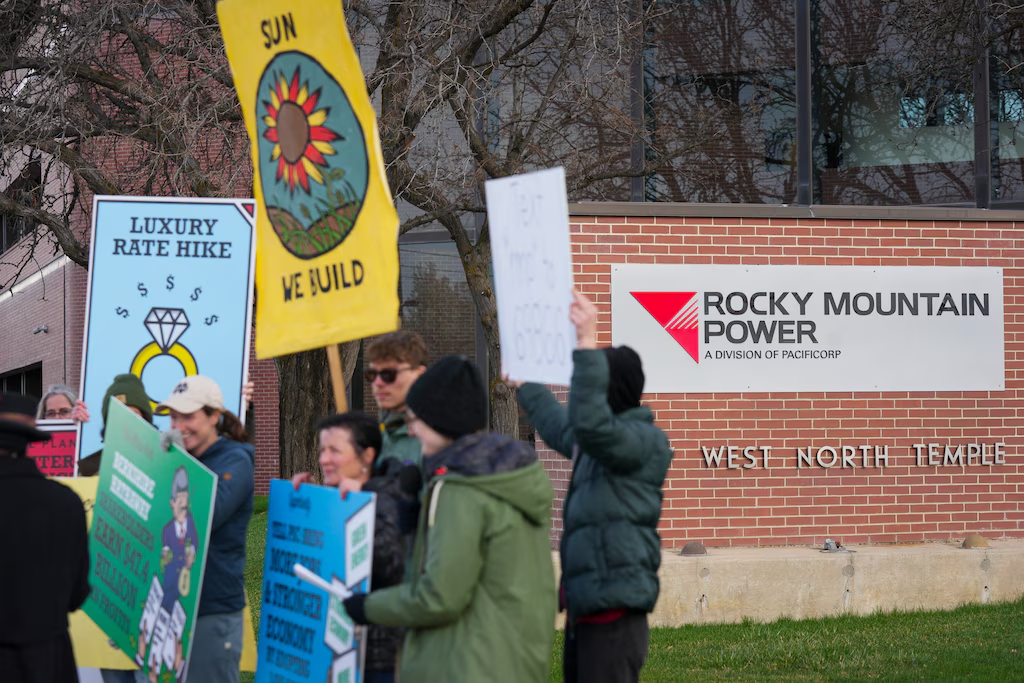
By Leia Larsen | The Salt Lake Tribune | Photo by Bethany Baker | The Salt Lake Tribune
Utah’s largest privately held utility released its latest plans for energy investments over the next three decades, and it’s significantly scaling back the amount of planned solar power generation.
Rocky Mountain Power releases its Integrated Resource Plan, a long-term prediction for future electricity needs, every two years. The latest plan published last year, but the utility provides periodic updates. And a new update has some environmental advocates steamed.
“It’s a major missed opportunity,” said Logan Mitchell, a climate scientist and energy advocate with Utah Clean Energy. “It will likely lock us into a more expensive generation mix that’s riskier and exposed to volatile fossil fuel prices.”
The original 2025 Integrated Resources Plan, or IRP, called for 4,765 new megawatts of utility scale solar by 2045. In the new update, released March 31, that investment is down to 2,477 megawatts.
Plans for new wind generation are down too, by about 80 megawatts. And the utility has downscaled its plans for batteries supporting those renewables by about 1,800 megawatts.
Instead, PacifiCorp signaled it plans to invest in another 2,222 megawatts of new natural gas generation across its six-state system.
In the interior states specifically, which include Utah, Idaho, Wyoming and a small part of California, investment in wind is down by 744 megawatts, Mitchell calculated, while utility and small-scale solar is down by 668 megawatts compared to just one year ago.
It appears to be a continuation of an ever larger pivot back to fossil fuels.
In the last IRP process, from 2023, Rocky Mountain Power and its parent company, PacifiCorp, announced big plans to retire multiple coal plants, including an accelerated retirement of the Huntington and Hunter plants in Emery County. It intended to build 40% more new solar farms than two years prior, and nearly triple the amount of wind power.
Now, the IRP shows investments in wind and solar across PacifiCorp’s regional service area are back to the original 2021 plan. Retirements of Huntington and Hunter are off the table for the near future.
In an emailed statement, a spokesperson for the electricity provider said the latest update’s changes are largely driven by the Trump administration’s repeal of “impactful tax benefits” for wind and solar from the Biden-era Inflation Reduction Act.
“It’s important to remember,” the spokesperson wrote, “that Rocky Mountain Power does not set energy policy.”
IRPs also aren’t set in stone, and are designed to embrace flexibility, the update document notes in the executive summary.
But clean energy advocates argue wind, solar and geothermal are better investments for long-term energy independence and stability, regardless of federal incentives.
“We mostly see wind and solar growing and a lot of interest in geothermal” in the U.S. market, said Erin Baker, a professor of mechanical and industrial engineering at the University of Massachusetts Amherst and director of the Energy Transition Institute.
The professor said she was surprised to see PacifiCorp pulling back on investments in renewables.
“It’s not obvious to me that it’s good business,” Baker said. “Doubling down on natural gas when we have an international war going on … it’s not clear to me why they would do that.”
The war in Ukraine has already caused a surge in natural gas prices, since Russia is a big supplier of the resource to Europe. And now the United States’ conflict with Iran is expected to throw the fossil fuel energy market into chaos across the globe, as reported by Brookings.
While coal and natural gas are produced locally in Utah, those worldwide market forces can still impact prices at home, since those energy markets are interconnected, Mitchell said. Iran may be able to block shipments of oil out of the Middle East, decreasing global supplies, but the sun shines everywhere for free.
In response to the criticism, the spokesperson for Rocky Mountain Power and PacifiCorp said that because policies in Washington and Oregon required the utility to move away from coal energy sources, that freed up more of those supplies for use in Utah and other interior states, making future demand for new generation sources lower.
Mitchel said more coal generation in Utah won’t necessarily mean lower bills for its ratepayers.
“They’re very old plants,” Mitchell said of the region’s coal stations, “and who’s going to pay for the depreciation or decommissioning of those plants is an ongoing and open question.”
Coal prices rose by nearly 24% in Utah and 28% nationwide between 2021 and 2024, according to Energy Innovation, a climate and energy policy think tank. That’s faster than the rate of inflation.
And burning fossil fuels has contributed to a warming West, fueling more demand for air conditioning and, by extension, more electricity.
While natural gas doesn’t produce regional haze or mercury like coal, and emits about half the amount of CO2, it’s still almost entirely composed of methane, a potent greenhouse gas.
“Sometimes people are not looking at the full cost of fossil fuels,” Baker said. “When you think about the health impacts and the climate impacts, then natural gas is much more expensive than renewable energy.”
Energy and consumer watchdogs are also concerned that Rocky Mountain Power’s Utah plan took large data centers out of its mix. Splashy announcements for massive new and expanded data complexes have been announced across the state, from Tooele to Millard. Combined, they could more than double or quadruple the energy that every business, industry and household currently consumes across Utah each day.
Those data center investors are mostly looking to build their own natural gas plants to generate their own power. A utility spokesperson noted the IRP opted not to include developments with large electricity needs while they remain speculative.
Mitchell also called out the latest plan’s reliance on market purchases from the regional Western grid to meet Utah’s growing needs. The update calls for 516 new megawatts of “block product,” or market purchases. That runs counter to Gov. Spencer Cox’s “Operation Gigawatt,” Mitchell said, which seeks to more than double the state’s energy production over the next decade.
“Utah is going to be more dependent on surrounding states for energy,” Mitchell said. “It increases our exposure to future higher market prices, which makes our future less certain.”
The latest plan update keeps an additional 500 megawatts of new emission-free nuclear on the grid, thanks to the Bill Gates-backed TerraPower small modular reactor under construction in Kemmerer, Wyoming. It’s slated to come online by 2032.
But Mitchell noted nuclear is among the most expensive energy resources, largely because of the up-front infrastructure costs, and that the Kemmerer reactor’s billionaire backing makes its price tag seem artificially low.
“It’s a great deal for us as ratepayers,” Mitchell said. “But it is a one-of-a-kind situation.”
Nuclear also takes a longer time to build and deploy than renewables, Mitchell added. TerraPower began building its Wyoming reactor in 2024, making it a nearly decade-long project, barring any hiccups with installing the fledgling small modular technology in the years ahead.
Fervo Energy, meanwhile, broke ground on its Beaver County geothermal project in late 2023, and is set to start supplying carbon-free power to the grid this year.
The 2023 IRP’s preferred portfolio included another 1,000 megawatts of nuclear in addition to the Kemmerer plant by the end of 2032, but the latest update does not include those sources.
The plan also does not factor in a planned sale of PacifiCorp’s assets in Washington, partly due to pressure from Utah lawmakers, because that divestment has not yet been finalized.
This story is made possible through a partnership between The Salt Lake Tribune and Grist, a nonprofit environmental media organization.
This article is published through the Utah News Collaborative, a partnership of news organizations in Utah that aims to inform readers across the state.