
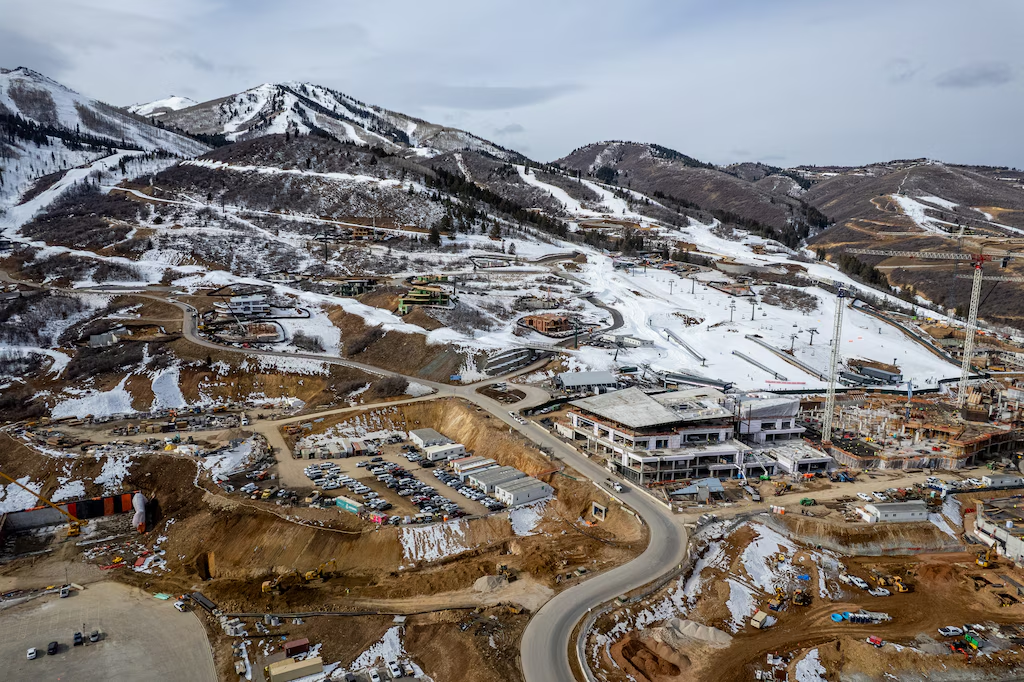
By Leia Larsen | The Salt Lake Tribune | Photo by Trent Nelson | The Salt Lake Tribune
Utah is experiencing its most dismal winter ever recorded.
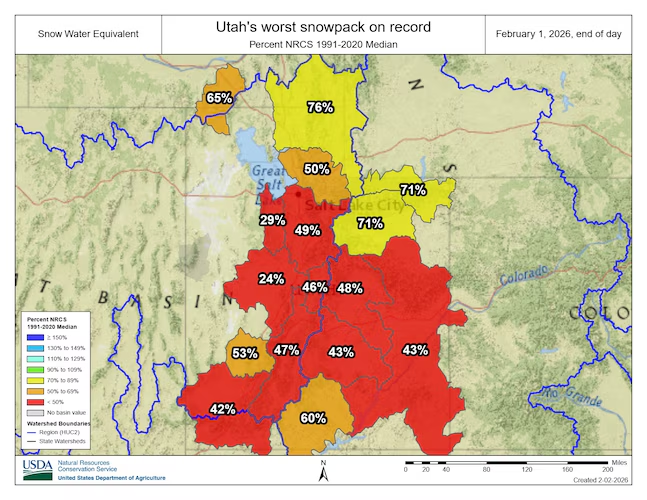
A special report issued Monday by the National Resources Conservation Service noted that snowpack levels measured across the state are among the lowest recorded since the SNOTEL measuring equipment was installed in 1980.
“That’s of concern to all of us, because snow does more for us than provide ski slopes,” said Jordan Clayton, supervisor of NRCS’s Utah Snow Survey. “It’s critical to us as a state.”
Of Utah’s major watersheds, four have record-low snow, including the Weber-Ogden, Provo-Jordan, Tooele Valley-Vernon Creek and Lower Sevier basins. Another six are on the brink of setting historic lows. Those include the Northeastern Uintas, San Pitch, Price-San Rafael, Dirty Devil, Upper Sevier and Southeastern Utah watersheds.
“It’s horrible,” said Scott Paxman, general manager and CEO of the Weber Basin Water Conservancy District.
Utah has 140 SNOTEL sites that transmit constant real-time data about snow depth and the water contained within that snow. As of Monday, 31 of those sites recorded the worst snow-water equivalent ever documented for this time of year. Another 12 stations showed the second-worst conditions on record.
Statewide, Utah has only about one-third of its normal snowpack for the start of February, and the season has only about two months left to accumulate snow before it begins to melt.
“It’s just been an outlier year,” said Glen Merrill, a hydrologist with the National Weather Service’s office in Salt Lake City. “We’ve been extremely dry.”
Utah and much of the West has been gripped by a high pressure system and dry conditions, Merrill added. The state saw record-breaking warm temperatures in November and December. Cold weather brought some relief in January, but temperatures are back to feeling like early spring.
“We’re beginning February hitting 50 [degrees] again,” Merrill said.
There’s a skiff of good news on the horizon. Forecasts call for cooler temperatures and more active storm activity by Feb. 11, Merrill said.
But the odds of sudden snowstorms making up for Utah’s snowpack deficit in the weeks ahead are only around 10%, he cautioned.
Communities across the state depend almost entirely on spring snowmelt for water supplies. More than 95% of the state’s water supply is directly tied to mountain snowpack, said Joel Ferry, executive director of the Department of Natural Resources. He said lawmakers will make water issues a top priority during the annual legislative session, which is currently underway.
“The policy changes and strategic investments we’ve made in conservation and infrastructure are helping to stretch our supply,” Ferry said, “but every Utahn across every sector must do their part to use this precious resource wisely.”
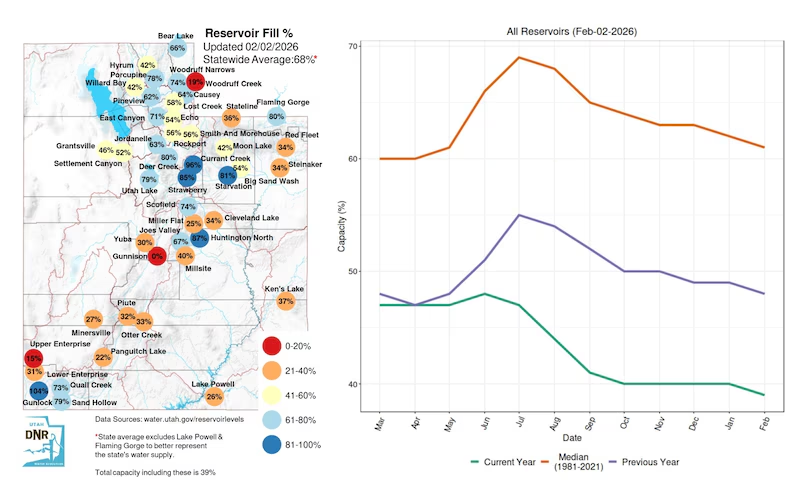
In northern Utah, major reservoirs range from 42% to 80% full, according to information from the Department of Natural Resources. The water situation is even more dire in southern Utah, where several reservoirs are less than 40% full. Lake Powell, the nation’s second-largest reservoir, sits at 26% of its capacity.
The Great Salt Lake is particularly vulnerable to northern Utah’s lack of snow. It depends on that runoff each spring to refill and make up for nearly 3 million acre-feet of water that evaporates over the summer and fall.
The salty inland sea currently sits about 3 feet above the record-low elevation set in late 2022, and the lake typically loses that many feet to evaporation each year.
“This record-low snowpack is a sobering reminder of the challenges we face,” said a spokesperson with the Great Salt Lake Commissioner’s Office, “and serves as a powerful motivator to accelerate our efforts to ensure the Great Salt Lake remains a top priority.”
Resource managers said they’re bracing for a year nearly as bad as 2022, when watering restrictions led to brown lawns, dead trees and difficult decisions for farmers. Cities may even have to enact drinking water restrictions, Paxman said.
“We [might] push the start date of irrigation back to May 15 or even first of June,” said Paxman, who manages one of the largest secondary outdoor water systems in the nation.
The silver lining this season, compared to 2022, is the amount of water still held in the soil. Soil moisture content is average or above normal for this time of year for almost all of the state, NRCS data show, thanks to rainfall in the fall. That means when the lackluster snowpack does melt, it will run off efficiently, Paxman said.
“It should go straight to rivers and reservoirs,” he said, unlike 2022, when the soil was bone dry. “Everything we got [then] pretty much sunk into the ground.”
In the years following the Great Salt Lake’s record low, water managers collaborated to identify surpluses and make donations to help the lake refill, especially following the record-breaking snowfall of 2023.
But donations to the lake this year appear unlikely, Paxman said.
“If this winter has taught us anything,” the Great Salt Lake Commissioner spokesperson said, “it’s that we can never take a ‘good’ water year for granted.”
Jacob Young, general manager and CEO of Jordan Valley Water District, said his agency hasn’t determined whether it will release additional water to benefit the lake, which typically happens at the end of the summer.
“It is largely dependent on how much water was conserved during the irrigation season,“ Young wrote in an email. ”This is another reason for our community to implement … water conserving measures.”
Skiers, snowboarders and winter nostalgists used social media to commiserate about Utah’s missing snow in recent weeks.
“It already seems like snowstorms are a thing of the past,” one Redditor wrote in the Salt Lake City forum Sunday, amassing more than 800 upvotes. “We’re going to be headed toward catastrophe very, very soon with the effects climate change is having on the Great Salt Lake.”